
Why We Don’t Stack Significant Cars
Gravity, vapour and fire: why every significant car at The Mews sits on its own floor space, with nothing above it and nothing beneath it.
Walk into most car storage facilities and the first thing you notice is the steel. Rows of four-post stackers, each one lifting a car into the air so a second car can be parked beneath it. It is an efficient use of floor space, and for a daily driver on a short stay it is perfectly reasonable.
For a significant car, we take a different view. Every car in our collector wing sits on its own floor space, with nothing above it and nothing beneath it. This is not a matter of style. It comes down to three forces that no amount of engineering can switch off: gravity, vapour and fire.
What leaks, falls
Cars at rest are not inert. Older cars in particular weep: a film of oil from a rear main seal, a bead of coolant at a hose clamp, a little brake fluid at a master cylinder. On the floor, that drop lands on a sealed concrete surface where it is noticed and cleaned. On a stacker, it falls through the open centre of the platform and lands on whatever is parked below.
That matters because some of these fluids are aggressive. Glycol-based brake fluid is a well-known paint hazard; manufacturers warn plainly that it will damage painted surfaces and should be cleaned off immediately. On a car that is sitting quietly beneath another for weeks, nobody is there to clean it off immediately.
A drop on the floor is a housekeeping task. A drop on a hand-finished bonnet is a refinishing job.
Vapour finds the low ground
Petrol does not need to spill to escape. Fuel systems breathe as the temperature rises and falls through the day, and older cars, built before modern evaporative controls, breathe more than most. The vapour they release is heavier than air. The UK Health and Safety Executive describes petrol vapour as tending to sink to a low level and collect where there is little air movement.
In a stacked arrangement, the car underneath sits in the path of whatever settles from the car above, and the sheltered space beneath a parked car is exactly the kind of low-movement pocket where vapour lingers.
A note on ventilation
Good ventilation matters, and we take it seriously. It dilutes vapour and carries it out of the building, and any facility worth considering should have it. But ventilation works on air, not on liquids, and it cannot change the direction something travels when it falls. It reduces the problem. Distance removes it.
Fire travels in every direction
Vehicle fires are rare. When they happen, the arrangement of the cars around them decides how far they go. On New Year’s Eve 2017, a fire in a single car at the Kings Dock multi-storey car park in Liverpool spread through the building. Merseyside Fire and Rescue Service’s incident report describes closely parked cars feeding heat to one another, and burning fuel running down from the level above. Around 1,150 vehicles were destroyed.
A stacker places one car’s fuel tank directly over another car’s roof. If the worst happens, burning fuel has a short and direct path down. Our collector wing is fitted with an integrated automatic fire suppression system, but the first line of protection is simply distance: a car with nothing above it cannot have fire fall onto it.
What about electric cars?
An electric car has no fuel to evaporate, so the vapour question falls away. Gravity and handling still apply. Fire is different rather than absent: battery fires are rare, rarer than petrol and diesel fires on the available data, but the NSW Government’s EV fire safety guidance notes that a battery in thermal runaway is difficult to extinguish and can take more time, water and firefighters to bring under control. Whatever powers it, a car stored above another shares its drips and its fire risk with the car beneath. On the floor, it shares nothing.
Every movement is a risk
There is also the matter of handling. A car on the lower level of a stacker cannot leave until the car above it is lifted out of the way, and every lift cycle is another moment where a car is raised, lowered, chocked and moved. Each one is small. Over months of ownership they add up.
Floor residency removes that sequence entirely. When a member calls ahead, their car is prepared and driven out under our two-hour Ready-to-Drive standard, without a single other car being moved to make way for it.
Questions worth asking any facility
Wherever you choose to keep a significant car, these are fair questions to put to the people who will be looking after it:
- Will my car ever be parked above or beneath another vehicle?
- How often will other cars be moved around mine?
- What fire suppression is installed, and where?
- How is the air managed, and how is the building sealed against dust and birds?
- How much notice do you need before I can drive my car?
What we do instead
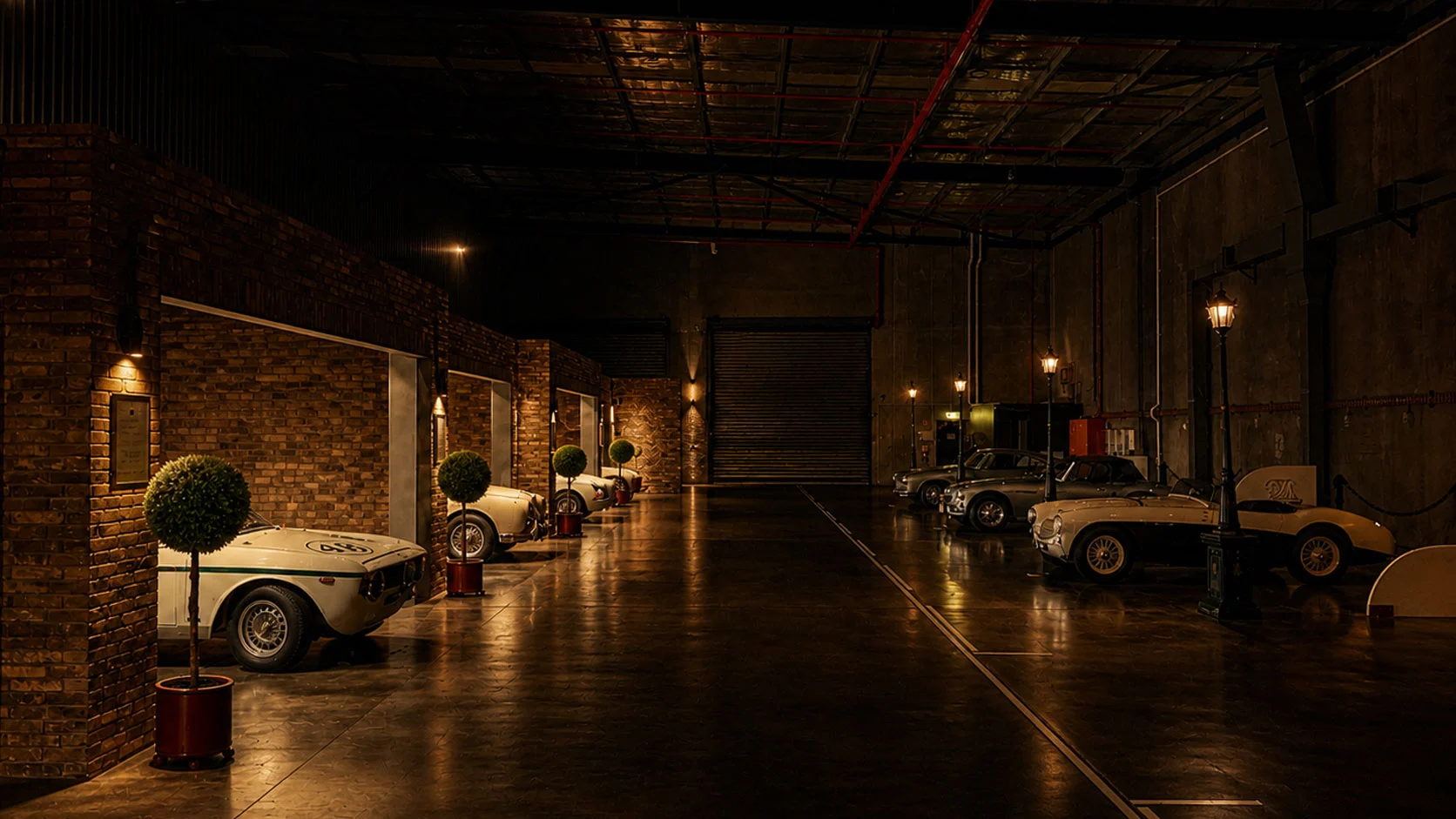
Every significant car at The Mews sits on its own floor space in an enclosed, air-filtered wing. Nothing is parked above it. Nothing is parked beneath it. It is a less efficient use of the building, and we are comfortable with that: the space is the point.
If you would like to see the collector wing for yourself, read more about non-stacking floor residency or request a confidential viewing.
References
- Health and Safety Executive (UK), Safe use of petrol in garages, INDG331 (rev1), 2013. hse.gov.uk
- Polaris owner’s manual, Brake fluid precautions: “Brake fluid will damage painted surfaces and plastic parts.” publications.polaris.com
- Merseyside Fire and Rescue Service, Kings Dock Car Park Fire: Significant Incident Report Summary, 2018. merseyfire.gov.uk
- BRE Global for the British Automatic Fire Sprinkler Association, research on fire spread in car park stacking systems, 2010. fmlink.com
- NSW Government, Vehicle Emissions Star Rating, Essential information about electric vehicle fire safety, 2025. vesr.gov.au
- State Farm, Classic car storage: common pitfalls and risks. statefarm.com
The video in this article is an illustrative visualisation created to explain the principles described, not footage of a specific event or of The Mews.